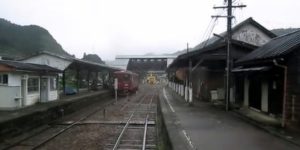
A trip on a local train in Gifu Prefecture.
It goes by express for Ogaki of the main Tokaido line to Gifu from Nagoya.
It is Takayama Line in Gifu. It regets and is to JR Mino-Oota.
It goes in Nagaragawa Tetsudo from Mino-Oota to Gujo Hachiman.
| Traffic | |
| Nagoya | |
| Train | Gifu |
| Mino oota | |
| Mino | |
| Gujyo | |
Nagaragawa Railway (Nagaragawa Tetsudo) is a railway company based in Gifu City, Gifu Prefecture, Japan. The company operates a 37.1-kilometer railway line connecting Gifu City with Tajimi City, Mizunami City, and Toki City.
The railway line of Nagaragawa Railway was originally operated by the Japanese National Railways (JNR) and was later privatized. The company currently operates tourist trains such as “Abeno Bridge” and “Shikishima” on the railway line.
Especially, the “Abeno Bridge” is a popular tourist train that allows passengers to enjoy the atmosphere of local trains with retro-style train cars and station buildings. From the train, passengers can also enjoy beautiful natural landscapes and views of the Nagara River flowing through Gifu City.
Nagaragawa Railway is also known for introducing women-only train cars, which is the only such service in Japan. The women-only train car provides a safe and comfortable space for female passengers, and includes amenities such as a powder room and luggage storage area.
What are Japan’s local lines?
In Japan, “local lines” (普通列車, Futsū ressha) refer to the regular commuter or local trains that run on the country’s extensive network of railways. These local lines typically serve shorter distances and stop at more stations than the faster express or limited express trains.
Japan’s local lines are operated by a number of railway companies, including Japan Railways (JR), which is the largest and most well-known railway operator in the country. Other major railway operators include private companies such as Tobu Railway, Keio Corporation, and Tokyo Metro.
Local lines are an important part of Japan’s transportation infrastructure, providing affordable and convenient access to urban and rural areas alike. They are particularly popular for commuting and short-distance travel, and many local lines offer frequent and reliable service, often running multiple trains per hour during peak periods.
While local lines are generally slower than express or limited express trains, they offer a more relaxed and comfortable travel experience, with more space for passengers and fewer crowds. They are also a great way to explore Japan’s local towns and villages and to experience the country’s scenic beauty up close.
History of Mino Ota Station, Gifu Prefecture.
Mino Ota Station is a train station located in the city of Minokamo, in the southern part of Gifu Prefecture, Japan. The station is part of the JR Takayama Main Line, which runs from Gifu City to Toyama City.
The history of Mino Ota Station dates back to the early 20th century. The station was first opened in 1905 as “Ota Station” by the Japanese National Railways, the predecessor of today’s Japan Railways (JR). At that time, the station served as an important transportation hub for the region, connecting local communities to nearby cities and towns.
During World War II, the station was heavily damaged by bombing, and it took several years to rebuild and restore service. In the postwar era, Mino Ota Station became an important center of commerce and industry, with the establishment of factories and businesses in the surrounding area.
In 1988, the station was renamed “Mino Ota Station” to reflect its location in the city of Minokamo. Today, Mino Ota Station serves as a major transportation hub for the region, with frequent service connecting it to Gifu City, Takayama, and other destinations throughout Gifu Prefecture and beyond.
In recent years, the station has undergone several renovations and upgrades, including the construction of a new platform and the installation of new elevators and escalators to improve accessibility for passengers.